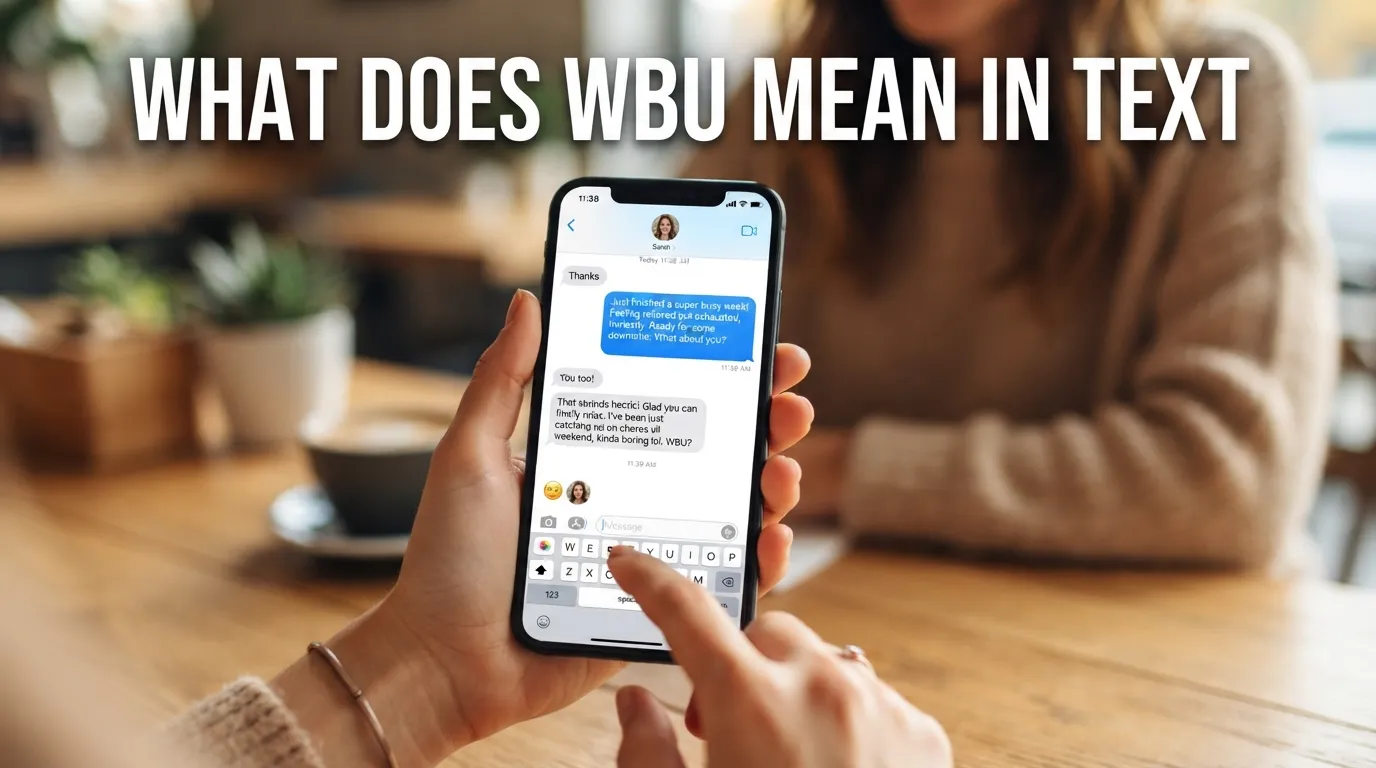
If someone sends you “WBU?” in a text message, WhatsApp chat, Instagram DM, or social media conversation, they are usually asking a simple question: “What about you?” It is a common texting abbreviation used to keep a conversation going without typing the full phrase.
People often search for the meaning of WBU because texting language is filled with shortened words, abbreviations, and slang. Understanding these expressions can make online conversations much easier, especially when someone uses an abbreviation you have not seen before.
WBU is generally informal and friendly. You may see it after someone has shared something about themselves, such as where they live, what they are doing, how their day went, or what they like. For example, if someone says, “I’m from Lahore. WBU?” they simply want to know where you are from.
The meaning can depend slightly on context, but in everyday texting, WBU almost always means “What about you?”
Meaning & Definition of WBU
WBU is an abbreviation for “What about you?” It is primarily used in informal digital communication. Instead of writing the complete question, people use the three-letter abbreviation to make their messages quicker and more casual.
For example:
- Person A: “I’m doing great. WBU?”
- Person B: “I’m good too!”
Here, WBU asks the other person to share their own situation or opinion.
The phrase usually works as a conversational follow-up. Someone first gives information about themselves and then uses WBU to invite the other person to respond with similar information. This makes it especially useful in short conversations.
Consider another example:
“I love watching cricket. WBU?”
The person is not asking a complicated question. They simply want to know whether you also enjoy cricket.
WBU can replace several longer questions depending on the subject. If someone says, “I’m studying computer science. WBU?”, it can mean “What are you studying?” If they say, “I’m free this weekend. WBU?”, it could mean “What are your plans?” The surrounding conversation determines exactly what information they want.
The abbreviation is normally written in capital letters as WBU, but lowercase wbu is also very common. There is no meaningful difference between the two forms. The lowercase version may feel even more casual because many people type informal messages without capitalization.
WBU is not normally considered formal English. It is better suited to conversations with friends, classmates, online acquaintances, or people who are comfortable with texting abbreviations. In professional communication, writing “What about you?” is generally clearer and more appropriate.
Background and Development of WBU
WBU developed as part of the broader culture of abbreviated digital communication. Text messaging, online chat rooms, instant messaging, and later social media encouraged people to communicate quickly using fewer characters.
Earlier forms of digital communication often had practical limitations. Mobile phones could make typing slow, and older SMS systems encouraged concise messages. As online conversations became more common, users developed shortcuts for phrases that appeared frequently.
Expressions such as “What about you?” naturally became candidates for abbreviation because they are commonly used as conversational follow-ups. WBU provides a fast way to return a question to another person.
The development of WBU is also connected to the wider family of internet abbreviations. Expressions such as WYD (“What are you doing?”), HBU (“How about you?”), IDK (“I don’t know”), BTW (“By the way”), and LMK (“Let me know”) became familiar in informal online communication.
WBU has remained useful because the underlying phrase is extremely common. Conversations frequently involve exchanging personal information, opinions, preferences, or experiences. Once one person answers a question, they often want to ask the same thing back.
For instance:
“My favorite movie is Interstellar. WBU?”
The abbreviation saves only a few characters, but its real value is conversational efficiency. It signals that the speaker is continuing the informal tone of the discussion.
The popularity of smartphones and social platforms has made abbreviations like WBU even more visible. However, digital language continues to change. Some abbreviations become less popular over time, while others remain widely understood because they represent everyday phrases.
WBU is best understood as a piece of informal internet and texting language rather than a separate English word. Its meaning comes directly from the phrase “What about you?”
WBU in Different Contexts: Chat, Social Media, and Professional Communication
The meaning of WBU remains fairly consistent across different digital platforms, but the tone and appropriateness can change depending on the setting.
In casual chat
WBU is very natural in conversations between friends or acquaintances.
“I’m staying home tonight. WBU?”
This means, “What about you? Are you staying home too, or do you have other plans?”
On social media
People may use WBU in comments, direct messages, or private conversations.
“I’m definitely choosing the blue one. WBU?”
The speaker is asking for your preference.
On platforms such as Instagram, TikTok, Facebook, and Snapchat, abbreviations help conversations feel quick and relaxed. WBU can therefore fit naturally into informal exchanges.
In professional communication
WBU is generally less suitable for formal business communication. If you are emailing a manager, client, professor, or professional contact, “What about you?” or a more specific question is usually preferable.
For example, instead of:
“I’m available Monday. WBU?”
a professional message could say:
“I’m available on Monday. What day works best for you?”
That version is clearer and more polished.
In academic communication
Among close classmates, WBU may be perfectly understandable:
“I finished the assignment. WBU?”
However, it would usually be better to avoid it in formal assignments, academic essays, applications, or official correspondence.
The important point is that WBU does not acquire a completely different meaning simply because it appears on a different platform. The main difference is how appropriate the abbreviation is for the audience and situation.
WBU Meaning in Chat, WhatsApp, Instagram, and TikTok
On messaging and social media platforms, WBU almost always means “What about you?”
WBU in WhatsApp
WhatsApp conversations are often informal, so WBU fits naturally.
“I’m going to the gym after work. WBU?”
The sender wants to know what you are doing.
WBU in Instagram messages
In an Instagram DM, WBU can be used after discussing interests, plans, or personal information.
“I love traveling. WBU?”
The sender is asking whether you enjoy traveling too.
WBU on TikTok
TikTok users may use WBU in comments or direct messages when responding to another person’s opinion.
“I think this trend is hilarious 😂 WBU?”
The meaning is still “What about you?” or “What do you think?”
WBU in ordinary text messages
Traditional SMS and modern messaging apps use the abbreviation in much the same way:
“I’m free tonight. WBU?”
It can also appear as wbu, Wbu, or WBU? The capitalization does not normally change its meaning.
WBU is especially useful when the question is already obvious from the previous message. If someone says, “My favorite food is pizza. WBU?”, the recipient immediately understands that they are being asked about their favorite food.
The abbreviation can also make conversations feel more reciprocal. Rather than simply talking about themselves, the sender uses WBU to show interest in the other person.
WBU Meaning in Physics, Medical, and Aircraft Terminology
One important distinction is that WBU is not a universally recognized technical term in physics, medicine, or aviation simply because it is a common texting abbreviation.
In everyday digital communication, WBU means “What about you?” However, technical fields sometimes use the same combination of letters as an acronym for specialized terms, organizations, procedures, equipment, or internal terminology.
Physics
There is no single standard physics definition of WBU that should automatically replace the common texting meaning. If you encounter WBU in a physics textbook, research paper, laboratory document, or technical diagram, the surrounding material should be checked for a field-specific definition.
Medical terminology
Likewise, WBU is not generally a universal medical abbreviation with one fixed meaning across all healthcare settings. Medical abbreviations can vary between specialties and institutions, and unfamiliar abbreviations should not be interpreted solely from their letters.
Aircraft and aviation
In aviation, abbreviations are highly dependent on the document or operational system in which they appear. WBU may potentially occur as an organization-specific, equipment-related, location-related, or procedural abbreviation, but it should not automatically be interpreted as “What about you?” in a technical aviation document.
This distinction matters because context determines meaning. In a WhatsApp message, “WBU?” is overwhelmingly likely to mean “What about you?” In a scientific, medical, or aviation document, the surrounding terminology should be used to establish the intended definition.
Common Misconceptions About WBU
One common misconception is that WBU has only one possible meaning in every situation. In texting, its standard meaning is “What about you?”, but acronyms can have different meanings in specialized environments.
Another misconception is that WBU is rude. Usually, it is not. It is simply an informal shortcut. Its tone depends more on the conversation than on the abbreviation itself.
For example:
“I’m having a good day, wbu?”
sounds casual and friendly.
However, if someone responds with only “WBU?” during a serious conversation, it could feel brief or uninterested depending on the circumstances. The abbreviation itself is not necessarily rude; the surrounding wording and relationship matter.
Some people also assume that WBU is identical to HBU in every situation. They are extremely similar, and both can often be translated as “What about you?” However, individual speakers may choose one based on habit or the wording of the preceding conversation.
Another misconception is that abbreviations such as WBU are appropriate everywhere. They are common in informal messaging but may look unprofessional in formal emails, reports, academic work, or business correspondence.
Finally, WBU should not automatically be confused with unrelated technical acronyms. When the abbreviation appears outside a casual conversation, especially in a specialized document, its meaning should be established from context.
Similar Terms and Alternatives to WBU
Several expressions can perform a similar conversational function.
HBU
HBU means “How about you?” It is one of the closest alternatives to WBU.
“I’m doing well. HBU?”
This is essentially asking the same type of follow-up question.
And you?
This is a natural English alternative:
“I’m from Pakistan. And you?”
It is slightly more conventional than using an abbreviation.
What about you?
This is the complete version of WBU:
“I like football. What about you?”
It is appropriate in both casual and many semi-formal conversations.
How about yourself?
This can sound a little more conversational or polite:
“I’m doing fine. How about yourself?”
You?
In extremely short chats, someone may simply write:
“I’m good. You?”
This communicates a similar idea but is even shorter.
The choice between these expressions depends on the tone of the conversation. WBU and HBU are particularly common in informal digital communication, while “What about you?” and “And you?” work well in ordinary spoken and written English.
How to Respond to WBU
The easiest way to respond to WBU is to answer the question that came immediately before it.
For example:
Them: “I’m from London. WBU?”
You: “I’m from Los Angeles.”
If someone says:
“I’m studying computer science. WBU?”
you might respond:
“I’m studying business.”
The answer does not need to be complicated. WBU is usually designed to continue the conversation, not create a formal exchange.
If you want to keep the conversation going, you can provide an answer and add another question:
“I’m watching a movie right now. WBU? What are you doing?”
In a friendly conversation, you can also answer playfully:
“I’m just relaxing 😄 WBU?”
If WBU appears in a dating conversation
A more engaging response can include some personal detail:
“I’m having coffee and trying to decide what to watch tonight. WBU?”
This gives the other person something to respond to.
If you do not understand the context
You can simply ask:
“Do you mean what about me?”
However, in ordinary texting, WBU is so commonly used for “What about you?” that clarification is rarely necessary.
WBU vs. Similar Words and Abbreviations
WBU is often compared with HBU, WYD, and other texting shortcuts, but they do not all ask the same question.
| Abbreviation | Meaning | Typical purpose |
| WBU | What about you? | Asking about the other person |
| HBU | How about you? | Asking the same question back |
| WYD | What are you doing? | Asking about someone’s current activity |
| IDK | I don’t know | Expressing uncertainty |
| LMK | Let me know | Asking someone to provide information later |
| BTW | By the way | Introducing additional information |
The main difference is that WBU is usually responsive. Someone gives information and then turns the conversation toward you.
For example:
“I love basketball. WBU?”
The subject is basketball, and the sender wants your opinion.
By contrast:
“WYD?”
directly asks what you are doing.
Similarly, HBU is nearly interchangeable with WBU in many casual conversations. The distinction is mostly linguistic rather than functional. “What about you?” and “How about you?” can both be used to return a question to the other person.
Understanding these differences prevents confusion when several texting abbreviations appear together.
Relevance in Online Conversations and Dating Apps
WBU is particularly useful in online conversations because it encourages reciprocity. A conversation can quickly become one-sided if only one person talks about themselves. Asking “What about you?” signals that the speaker is interested in hearing the other person’s answer.
This is especially noticeable on dating apps. Someone might write:
“I love hiking and trying new restaurants. WBU?”
The person is inviting the other individual to share their interests. A thoughtful response can therefore help the conversation develop naturally.
For example:
“I’m more into photography and long walks, but I definitely enjoy trying new restaurants too.”
That answer gives the other person multiple topics to continue discussing.
WBU can also appear after questions about location, work, education, hobbies, weekend plans, music, movies, or relationship preferences.
For example:
“I’m a software student and I play cricket on weekends. WBU?”
A response could be:
“I’m studying business, and I usually spend my weekends with friends.”
The abbreviation itself does not indicate romantic interest. It simply means “What about you?” Its meaning in a dating conversation comes from the broader context.
If someone repeatedly asks WBU-style questions, however, they may be showing that they want to learn more about you. The level of interest should be judged from the overall conversation rather than from the abbreviation alone.
Conclusion
WBU means “What about you?” in text and most informal online conversations. It is a short, convenient abbreviation commonly used in text messages, WhatsApp chats, Instagram DMs, TikTok conversations, and other social platforms.
People generally use it after sharing something about themselves and wanting the other person to answer the same type of question. For example, “I’m doing well, WBU?” simply means “I’m doing well; what about you?”
WBU is informal, so it is best suited to casual conversations rather than formal emails, academic writing, or professional documents. It is closely related to HBU, which means “How about you?” and often serves the same conversational purpose.
If you receive “WBU?”, the simplest response is to answer the question being discussed. In most everyday texting situations, there is no hidden meaning the sender is simply turning the conversation back to you.

Ethan Parker is a professional content writer and researcher at Guestreachs.com, specializing in word, phrase, and slang meanings. His goal is to provide accurate, straightforward explanations that help readers understand unfamiliar terms with ease.