If you have received a message containing the 🥸 emoji and wondered what the sender was trying to say, you are not alone. The disguised face emoji can communicate several playful ideas depending on the conversation, relationship, and surrounding words.
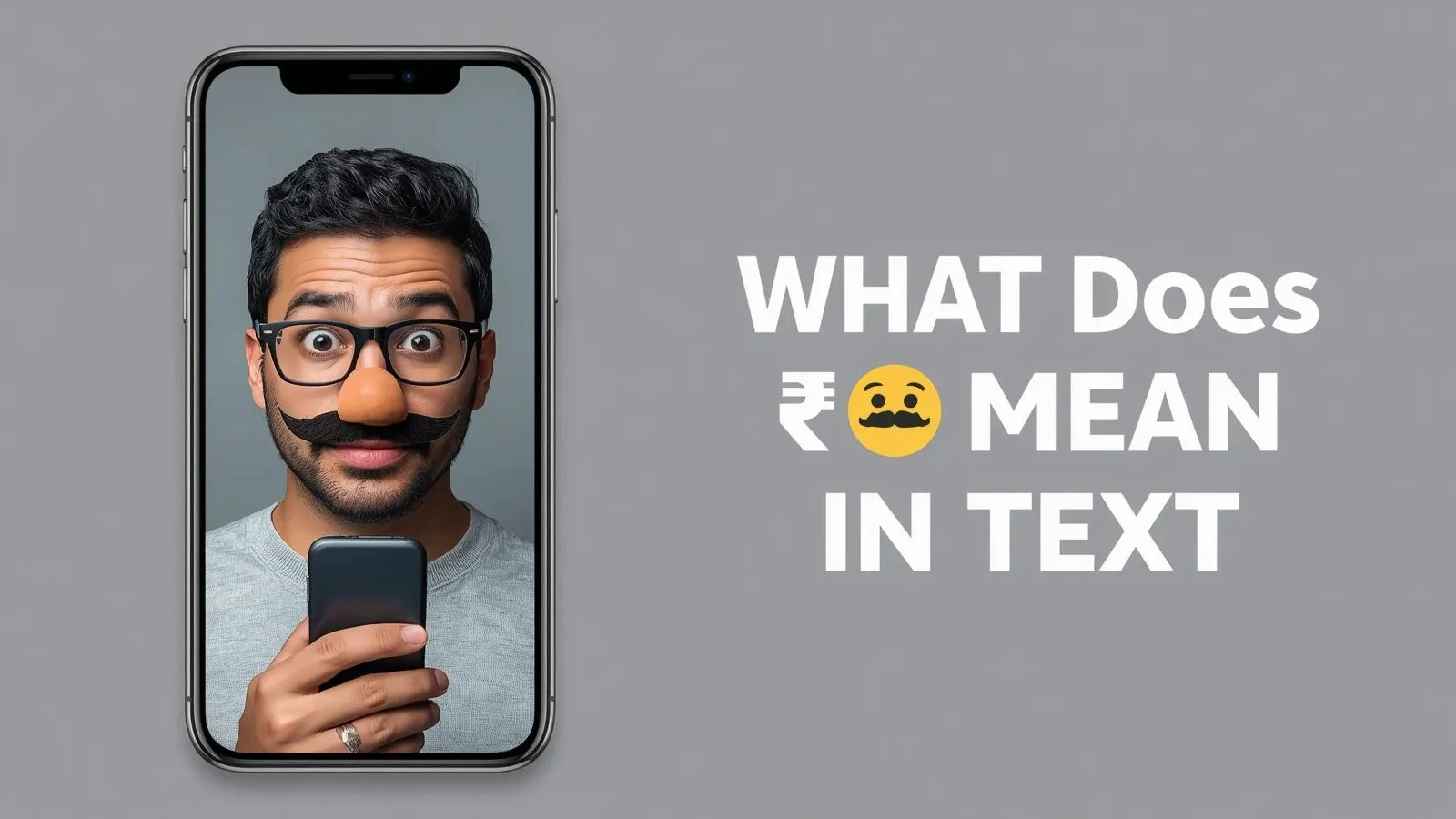
Officially, 🥸 represents a face wearing a disguise, including glasses, a fake nose, eyebrows, and a mustache. In everyday texting, however, people often use it to suggest that they are pretending, hiding something, being sneaky, joking around, or playfully avoiding recognition.
People search for what does 🥸 mean in text because emojis rarely have just one fixed conversational meaning.
The same emoji can express humor in one message and suspicion or secrecy in another. Understanding the context is therefore more important than simply memorizing a definition.
If you see 🥸 on WhatsApp, Instagram, TikTok, a dating app, or another messaging platform, its meaning usually revolves around disguise, pretending, mischief, or playful secrecy.
Meaning & Definition of 🥸
The 🥸 emoji is commonly known as the disguised face emoji. Its visual design shows a face wearing a comical disguise, traditionally featuring oversized glasses, a fake nose, prominent eyebrows, and a mustache.
The design itself gives the emoji its central idea: someone is attempting to look different or hide their identity.
In text conversations, 🥸 can therefore mean “I am disguised,” “I am pretending,” “I am hiding,” or “I am being sneaky.” It can also be used simply because something feels funny or suspicious.
For example:
- “I wasn’t there last night 🥸” can jokingly suggest that the person is pretending to deny something.
- “Just checking your profile 🥸” may indicate playful curiosity.
- “Who, me? 🥸” can make a denial sound humorous.
- “I have a secret 🥸” can create a playful sense of mystery.
The emoji does not automatically mean that someone is lying. In many cases, it is simply a humorous way of making a statement less serious.
The surrounding text is important. If someone writes “I definitely didn’t eat your fries 🥸,” the emoji may suggest that the speaker is jokingly acting innocent. If someone says “Going undercover today 🥸,” the meaning is much closer to literal disguise or secrecy.
Another important point is that emojis communicate tone as much as literal meaning. Without 🥸, a sentence such as “I know what you did” might sound serious. Adding the emoji can turn it into playful teasing.
So, the simplest definition is: 🥸 usually represents pretending, disguise, secrecy, mischief, or playful deception. The exact interpretation depends on the situation and the relationship between the people communicating.
Background of the 🥸 Emoji
The idea behind 🥸 comes from the familiar concept of a humorous disguise. A fake mustache, oversized glasses, and artificial nose are classic visual symbols of someone trying to hide their identity.
The emoji transforms that recognizable idea into a small digital character that can be inserted into everyday conversations.
Like many modern emojis, 🥸 became useful because digital communication often lacks the facial expressions and gestures people naturally use during face-to-face conversations.
A person speaking in person can raise their eyebrows, smile, or make a playful expression to show that they are joking. In a text message, those signals are missing. An emoji can help restore some of that emotional context.
The disguised face design is particularly useful for expressing playful behavior. Instead of writing a long explanation such as “I’m pretending that I don’t know anything,” someone can simply add 🥸 after a sentence.
The emoji can also create an exaggerated personality. Someone might use it when pretending to be a detective, going “undercover,” secretly checking something, or joking about getting away with something.
For example:
“I definitely didn’t look at your old posts 🥸”
Here, the emoji helps communicate that the statement is probably playful rather than a serious declaration.
The background idea also explains why the emoji sometimes appears alongside words such as “secret,” “undercover,” “sneaky,” “pretending,” and “innocent.” These concepts all connect naturally to the visual symbolism of disguise.
However, the emoji should not be treated as having a rigid dictionary definition. Digital communication changes quickly, and individual users develop their own habits. One person may use 🥸 whenever they are joking, while another may specifically use it to indicate secrecy.
Its meaning can also change according to the platform and conversation. A TikTok comment may use it for comedic effect, while a private WhatsApp message may use it as a teasing response between friends.
The enduring concept behind 🥸 remains relatively simple: a playful disguise or an attempt to appear different from reality. Modern users then adapt that concept to countless conversational situations.
Usage in Different Contexts
The 🥸 emoji can appear in casual conversations, social media posts, jokes, comments, memes, and even situations where someone wants to soften a potentially suspicious statement. Its meaning depends heavily on the context.
In casual chat
Friends may use 🥸 when teasing each other or pretending to be innocent.
“I didn’t finish the cake 🥸”
The speaker may actually have finished it and is jokingly denying responsibility.
In social media
On social platforms, 🥸 can accompany humorous captions or comments. Someone might use it after admitting to secretly checking another person’s profile.
“Just doing some research 🥸”
The emoji makes the statement sound playful and mischievous.
When joking about secrecy
It can also suggest that someone knows something but does not want to reveal it.
“I know something you don’t know 🥸”
Here, the emoji adds a mysterious, teasing tone.
When pretending
Someone might use 🥸 to show that they are acting as though they are someone else.
“Nobody will recognize me today 🥸”
The intended meaning is usually humorous rather than literal.
When acting suspicious
The emoji can sometimes communicate a tongue-in-cheek form of suspicion.
“Hmm… interesting 🥸”
In this context, it may suggest that the person is observing something carefully or pretending to investigate.
In professional communication
Using 🥸 in professional communication is less common. It may be appropriate in an informal workplace chat among colleagues who already have a friendly relationship, especially when discussing a harmless joke or playful situation.
However, it is generally unsuitable for formal emails, official reports, client communication, or serious workplace discussions.
The important lesson is that 🥸 is primarily a tone-setting emoji. It can make a sentence feel humorous, secretive, mischievous, or intentionally playful. The words surrounding it determine which interpretation makes the most sense.
Meaning in Chat, WhatsApp, Instagram, and TikTok
The meaning of 🥸 is broadly similar across messaging and social media platforms, but people may use it differently depending on the environment.
On WhatsApp, 🥸 is commonly used in private conversations between friends, family members, or partners. It can indicate playful secrecy or joking deception.
“I may have a surprise for you 🥸”
The emoji suggests that the sender is hiding something.
It can also be used after a playful confession:
“Okay, maybe I ate the last slice 🥸”
On Instagram, 🥸 can appear in comments, captions, direct messages, or replies. Users may employ it when making a humorous observation or teasing someone.
For example:
“Checking out the competition 🥸”
This can suggest playful curiosity rather than serious competition.
TikTok
TikTok culture frequently relies on humor, exaggeration, irony, and reaction-based communication. In that environment, 🥸 may be used to make a comment appear intentionally suspicious or mischievous.
Someone might comment:
“I wasn’t watching this video for the fifth time 🥸”
The emoji reinforces the joke.
Group chats
In group conversations, 🥸 can signal that someone is pretending not to know what is happening.
“I have absolutely no idea who started this 🥸”
It can also be used when someone wants to joke about being “undercover.”
Direct messages
In one-to-one conversations, interpretation depends more strongly on the relationship. Between close friends, it may simply be playful. Between romantic partners, it might indicate teasing or hiding a surprise.
The emoji is therefore not tied to one particular platform. Across WhatsApp, Instagram, TikTok, and other services, its central themes remain disguise, pretending, secrecy, and playful mischief.
Still, users should avoid assuming that 🥸 always means someone is actually hiding something. Emojis often exaggerate a message for comedic effect.
Meaning in Physics, Medical, and Aircraft Terminology
If you are searching for the meaning of 🥸 in physics, medicine, or aviation, there is an important distinction to understand: the 🥸 emoji does not have a standard technical definition in these professional fields.
Physics
In physics, symbols are normally defined mathematical or scientific notation. 🥸 is not a recognized standard physics symbol for a physical quantity, law, unit, particle, or equation. If you encounter it in a physics discussion, it is most likely being used informally to express humor, confusion, secrecy, or a playful reaction.
Medical terminology
Similarly, 🥸 is not a standard medical abbreviation or diagnostic symbol. A medical professional might use the emoji casually in an informal message, but it should not be interpreted as a clinical term without additional context.
Medical abbreviations can vary significantly between institutions, so an unfamiliar symbol in medical documentation should always be interpreted from the actual document and professional context rather than from emoji meanings.
Aircraft and aviation
The disguised face emoji also has no standard aviation meaning. It does not officially represent an aircraft component, flight procedure, aviation code, airport designation, or aircraft system.
Someone discussing aviation online might use 🥸 humorously, perhaps while joking about being an “undercover pilot” or hiding their identity. That would be conversational use rather than technical terminology.
This distinction matters because the same characters or symbols can sometimes have unrelated meanings in specialized fields. A technical abbreviation should not automatically be interpreted using an emoji’s everyday meaning.
Therefore, if you encounter 🥸 in a physics, medical, or aircraft-related conversation, examine the surrounding text carefully. As an emoji, its usual meaning remains disguise, pretending, secrecy, or playful mischief not a specialized scientific or professional term.
Common Misconceptions About 🥸
Several misunderstandings can arise when people interpret the disguised face emoji too literally.
Misconception 1: It always means lying
Not necessarily. 🥸 can accompany a joke, playful denial, teasing, or harmless pretending. Someone saying “I didn’t eat the cookies 🥸” may simply be joking.
Misconception 2: It means someone is hiding their identity
The literal image suggests a disguise, but conversational use is often metaphorical. A person may use it to mean “I’m being sneaky” without actually concealing their identity.
Misconception 3: It always indicates suspicious behavior
The emoji can suggest suspicion, but it is frequently used for comedy. Tone matters.
Misconception 4: It has a secret technical meaning
Outside casual communication, 🥸 does not have a universally recognized technical definition in physics, medicine, or aviation.
Misconception 5: It has the same meaning in every message
Context changes interpretation. “I have a secret 🥸” and “Look who’s here 🥸” can communicate different shades of meaning.
Misconception 6: It is automatically romantic
A person may use 🥸 in flirting or dating, but the emoji itself is not inherently romantic. The relationship and surrounding words determine whether it has a flirtatious meaning.
The safest approach is to interpret 🥸 alongside the entire message. Look at what was said immediately before it, the person’s usual communication style, and the nature of your relationship.
If the message remains unclear, asking a simple question is better than assuming the sender is accusing, deceiving, or flirting with you.
Similar Terms & Alternatives
Several words and emojis can communicate ideas that overlap with 🥸, although they are not identical.
Similar words
- Sneaky — suggests secretly doing something.
- Undercover — suggests hiding one’s identity or purpose.
- Secretive — describes keeping information private.
- Pretending — acting as though something is true when it is not.
- Mischievous — playfully causing trouble.
- Suspicious — suggesting that something may not be trustworthy.
- Incognito — hiding one’s identity.
Similar emojis
Depending on the intended tone, users might choose different emojis:
- 😏 — often suggests confidence, teasing, or suggestiveness.
- 🤫 — commonly indicates keeping quiet or maintaining secrecy.
- 🕵️ — represents investigation or detective-like behavior.
- 🤭 — can express amusement, embarrassment, or hiding a reaction.
- 😎 — may convey confidence or a cool attitude.
- 😂 — emphasizes that something is funny.
However, these alternatives are not interchangeable. 🥸 specifically brings the visual idea of a disguise or fake appearance.
For example, “I’m keeping this secret 🤫” directly emphasizes silence. “I’m investigating this 🕵️” emphasizes investigation. “I’m undercover 🥸” emphasizes disguise and playful concealment.
Choosing the right emoji can therefore change the emotional tone of the sentence. Someone who wants to make a joke about pretending to be innocent may prefer 🥸, while someone genuinely asking another person to keep quiet might use 🤫.
How to Respond to 🥸
The best response depends on what the sender means. If the emoji is clearly being used jokingly, responding with humor usually works well.
For example:
If they say:
“I didn’t do anything 🥸”
You could reply:
“Sure you didn’t 😂”
If someone sends:
“I have a secret 🥸”
You might answer:
- “Okay, now I’m curious 👀”
- “Tell me!”
- “What are you hiding? 😂”
- “I knew you were up to something.”
If the person is being playful:
“Going undercover today 🥸”
You could respond:
“Mission accepted 🫡”
If you are unsure what they mean, a direct response is perfectly acceptable:
“What does the 🥸 mean here? 😂”
In a professional conversation, it may be better to respond to the actual words rather than trying to interpret the emoji too deeply.
The key is to match the sender’s tone. If they are joking, a light response is appropriate. If the context involves something serious, do not assume the emoji automatically makes the statement harmless.
Differences From Similar Words and Emojis
Although 🥸 overlaps with several concepts, it has a distinctive tone.
| Expression | Main idea | Typical tone |
| 🥸 | Disguise, pretending, playful secrecy | Humorous/playful |
| 🤫 | Keeping something quiet | Secretive |
| 🕵️ | Investigating or observing | Curious/investigative |
| 😏 | Teasing or suggestive confidence | Flirty/teasing |
| 😎 | Confidence or being cool | Confident |
| “Sneaky” | Secretly doing something | Playful or suspicious |
| “Undercover” | Concealing identity or purpose | Secretive/playful |
| “Pretending” | Acting differently from reality | Neutral/playful |
The biggest difference is that 🥸 combines disguise with humor. It visually resembles someone putting on a fake identity, which makes it especially useful for jokes about pretending to be innocent or going unnoticed.
For example, “I’m undercover” is a statement. “I’m undercover 🥸” turns that statement into something more playful and visually expressive.
Likewise, “I’m innocent 🤫” and “I’m innocent 🥸” have different emotional flavors. The first can sound like a request for secrecy, while the second can imply humorous pretending.
Context still matters more than the emoji itself. A person may use 🥸 simply because they like its appearance or because it fits a meme.
Relevance in Online Conversations and Dating Apps
On dating apps, 🥸 can be especially useful for adding humor to a conversation. Dating conversations often depend on tone, and emojis help prevent playful comments from sounding overly serious.
For example:
“So you finally matched with me 🥸”
This might be a teasing way to start a conversation.
Someone might also write:
“I may have looked at your profile a little too much 🥸”
Here, the emoji suggests playful embarrassment or pretending not to admit something.
Another example:
“I’m definitely not trying to impress you 🥸”
The emoji can make the statement sound intentionally ironic.
However, 🥸 should not automatically be interpreted as flirting. If someone sends it without other romantic or playful signals, it may simply be a joke.
In online conversations generally, the emoji can also help communicate irony. Text lacks vocal tone, so a short sentence can sometimes be misunderstood. Adding 🥸 may signal that the sender is deliberately being playful.
It is particularly relevant when someone is:
- Pretending to be innocent
- Making a playful confession
- Hiding a harmless surprise
- Joking about secretly checking something
- Acting “undercover”
- Teasing another person
- Making an ironic statement
When interpreting the emoji on a dating app, consider the entire conversation rather than relying on one symbol. Look for patterns in the person’s messages, their wording, and whether they are consistently playful or flirtatious.
The safest interpretation is usually the simplest: the person is adding a playful disguise, secrecy, or mischievous tone to what they are saying.
Conclusion
The 🥸 emoji, commonly called the disguised face emoji, represents the idea of wearing a disguise or pretending to be someone else. In everyday texting, its meaning extends beyond the literal image.
People use it to communicate playful secrecy, mischief, humorous denial, pretending, undercover behavior, or a joking attempt to look innocent.
Its meaning can change according to context. On WhatsApp, Instagram, TikTok, group chats, and dating apps, it is generally informal and playful.
In professional, medical, physics, or aviation contexts, it has no standard technical definition and should not be treated as a specialized abbreviation or symbol.
If someone sends you 🥸, consider the words around it and the relationship you have with that person. Most of the time, it is simply a fun way to add mystery or humor to a message.