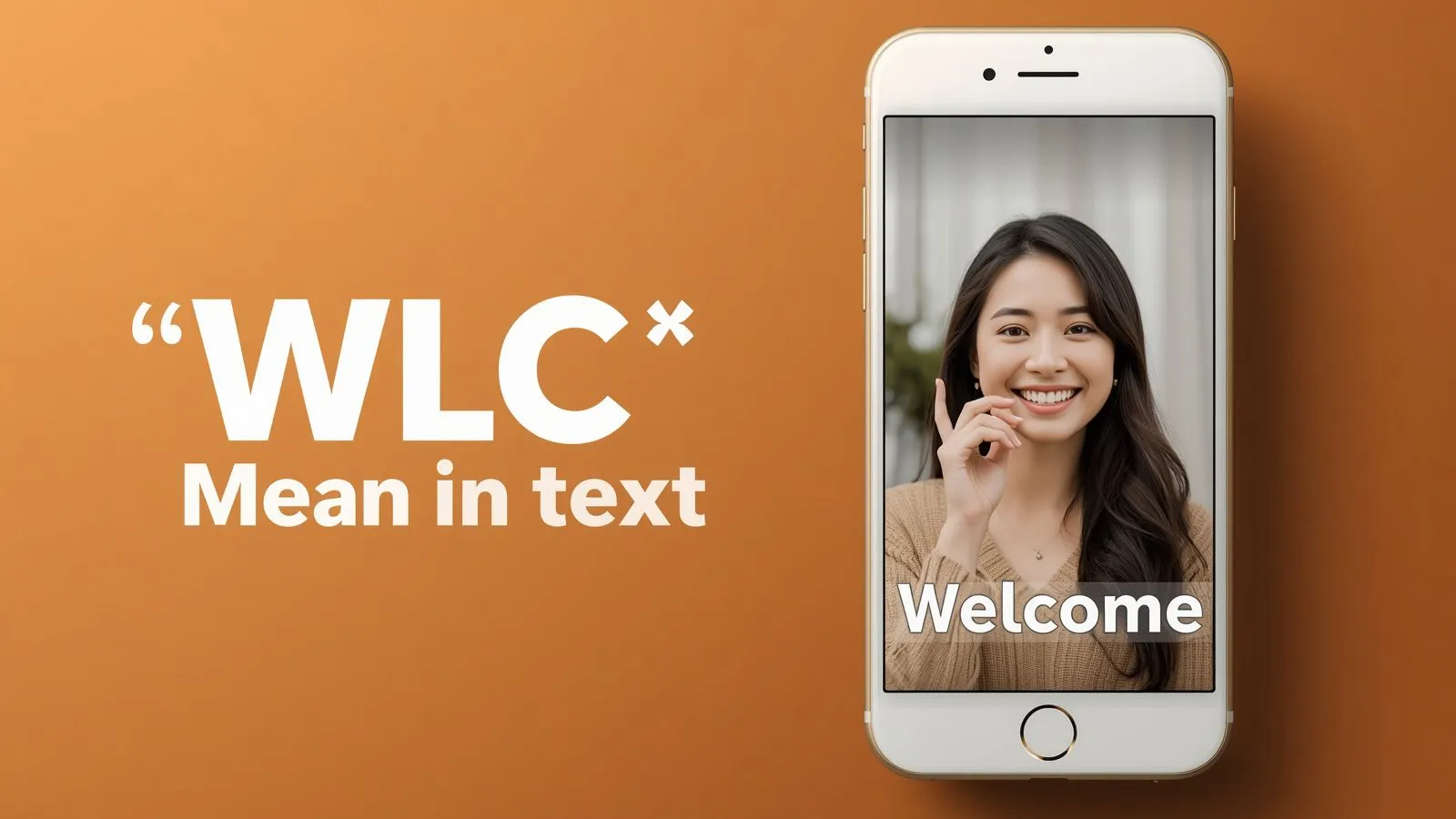
If someone sends you “WLC” in a text message, you may wonder what these three letters mean. In casual online conversations, WLC usually means “welcome.”
It is a shortened form people use when chatting quickly, especially after someone says “thanks” or “thank you.” For example, if a friend says, “Thanks for helping me,” you might simply reply, “WLC!”
However, abbreviations can have different meanings depending on the situation. WLC may appear in social media conversations, professional environments, technical discussions, or specialized fields, where its meaning can change completely.
This is why people often search for the meaning of WLC when they encounter it without enough context.
In this guide, we will explain what WLC means in texting, WhatsApp, Instagram, TikTok, dating conversations, and professional communication. We will also look at some less-common technical meanings and explain how to respond naturally when someone uses WLC.
Meaning & Definition
In texting and casual online communication, WLC most commonly means “welcome.” It is an abbreviated version of the word that people use to acknowledge someone’s thanks.
For example:
- Person A: “Thanks for sending me the notes.”
- Person B: “WLC!”
Here, WLC simply means “You’re welcome.” Depending on the conversation, it can also carry the friendly feeling of “No problem,” “Anytime,” or “My pleasure.”
The abbreviation is especially useful in fast-paced conversations where people prefer short expressions. Instead of typing the complete phrase “You’re welcome,” someone may type WLC to save time.
WLC is generally informal. You are more likely to encounter it in text messages, group chats, gaming conversations, comments, and social-media messages than in formal writing.
The exact tone depends on the surrounding conversation. A simple “WLC” may sound casual and efficient, while “WLC 😊” can feel warmer and friendlier. Likewise, “wlc” written in lowercase usually has the same basic meaning and does not necessarily indicate a different definition.
It is important not to assume that every occurrence of WLC means “welcome.” Acronyms are often reused in different industries and communities. If WLC appears in a technical document, medical discussion, engineering report, or aviation material, the surrounding terminology should be considered before interpreting it.
For everyday texting, however, “welcome” is the most likely interpretation, particularly when WLC appears as a response to “thanks.”
Background
Texting abbreviations developed largely because digital communication encouraged people to write quickly and efficiently. Early text messaging had practical limitations, and users naturally developed shortened forms of common expressions.
Internet chatrooms, forums, gaming communities, and later social-media platforms continued this habit.
WLC fits into this broader culture of shortening familiar words and phrases. Instead of typing a complete response such as “You’re welcome,” some users prefer a compact form. Similar behavior can be seen in expressions such as “thx” for “thanks,” “pls” for “please,” and “msg” for “message.”
Unlike some slang expressions that have a complicated cultural history, WLC is relatively straightforward when used as “welcome.” Its popularity can vary from one online community to another, so you may see it frequently in some conversations and rarely in others.
Another reason abbreviations can be confusing is that the same three letters may represent completely different phrases. A person working in technology, engineering, medicine, or aviation may use WLC as an acronym for a specialized term. Someone chatting with friends, on the other hand, is much more likely to use it as a casual shortening of “welcome.”
Context therefore plays an important role. If WLC appears immediately after someone says “thank you,” its meaning is usually easy to identify. If it appears in a technical report surrounded by industry-specific terminology, interpreting it as “welcome” would probably be incorrect.
The important point is that WLC does not have one universal meaning in every situation. Its everyday texting meaning is simple, but specialized uses require additional context.
Usage in Different Contexts
The meaning of WLC depends heavily on where and how it is used. In casual communication, the abbreviation generally has a conversational purpose. Someone may write “WLC” after receiving thanks, accepting appreciation, or acknowledging a polite message.
In personal chats, it can function as a quick version of “you’re welcome.” Friends may use it without worrying about formal grammar or capitalization.
In social media, WLC may appear in direct messages, comments, captions, or group conversations. For instance, a user might thank someone for sharing information, and the other person could answer with “WLC.” The exact style varies between communities.
In professional fields, however, WLC may represent an entirely different concept. Acronyms are common in business, engineering, computing, transportation, and other specialized areas. Professionals often rely on abbreviations to make technical communication more efficient.
For example, in some engineering and business contexts, WLC can refer to “Whole Life Cost” or “Whole Life Costs.” This describes the total cost associated with an asset over its useful life rather than merely its initial purchase price.
In networking, WLC can mean “Wireless LAN Controller,” a device or system used to centrally manage wireless networks. In that setting, interpreting WLC as “welcome” would obviously be inappropriate.
There can also be organization-specific meanings that are not widely recognized outside a particular workplace or industry. Therefore, when you see WLC in a professional document, look at the surrounding terminology or any abbreviation list provided by the organization.
A useful rule is simple: casual conversation usually favors the everyday meaning, while technical context may indicate a specialized acronym.
Meaning in Chat, WhatsApp, Instagram, and TikTok
On messaging and social platforms, WLC is most commonly understood as a short form of “welcome” or “you’re welcome.” The meaning is particularly clear when it appears directly after a person expresses gratitude.
For example:
WhatsApp:
“Thanks for helping me with the assignment.”
“WLC bro!”
Instagram DM:
“Thank you for sharing my post.”
“WLC 😊”
TikTok comments or messages:
“Thanks for explaining this trend!”
“WLC!”
In these examples, the person using WLC is responding positively to appreciation. It generally does not carry a hidden or complicated meaning.
However, online language is flexible. Some people may use WLC simply because they prefer abbreviations, while others may choose the complete word “welcome.” The level of familiarity between the people communicating can also influence the choice.
Capitalization is usually unimportant. WLC, wlc, and occasionally Wlc can all communicate the same idea in informal texting.
If you encounter WLC in a TikTok, Instagram, or WhatsApp conversation where nobody has said “thanks,” context becomes more important. It could potentially represent another phrase or an inside abbreviation known to that particular group.
When interpreting slang or abbreviations online, read the complete message instead of focusing only on the three letters. The words immediately before and after WLC usually provide enough information to determine what the sender intended.
For everyday social-media conversations, though, “welcome” remains the most natural interpretation when WLC is used as a reply to gratitude.
Meaning in Physics, Medical, and Aircraft Terminology
WLC can have specialized meanings outside everyday texting, but these uses are not universal. The exact definition depends on the field, organization, textbook, or technical standard involved.
In physics, WLC may appear as an abbreviation within a particular research area or technical document. Acronyms in physics are often highly specialized, and the same abbreviation can mean different things in different subfields.
Therefore, WLC should not automatically be interpreted as “welcome” or assigned one fixed physics definition without the surrounding material.
In medical terminology, people sometimes confuse WLC with similar abbreviations. For example, WBC commonly refers to “white blood cell” or “white blood cell count,” whereas WLC is not a universal replacement for WBC.
If you encounter WLC on a medical report, the safest approach is to check the report’s abbreviation key or ask the healthcare professional who issued it.
In aircraft and aviation terminology, WLC can likewise have specialized meanings depending on the document or aviation system. Aviation uses many abbreviations for aircraft components, performance measurements, procedures, and organizations.
A three-letter abbreviation should therefore be interpreted according to the specific aviation context.
This distinction matters because acronyms are not always standardized across industries. An abbreviation used by one manufacturer, research group, company, or technical manual may not have the same meaning elsewhere.
Consequently, if WLC appears in a physics paper, medical report, or aircraft document, do not assume that it means “welcome.” Identify the surrounding terminology first. In ordinary texting, the conversational meaning is usually obvious; in specialized fields, context is essential.
Common Misconceptions
One common misconception is that WLC always means “welcome.” This is true in many casual conversations, but not in every situation. Acronyms can have multiple definitions, and technical industries frequently use the same letters for unrelated concepts.
Another misconception is that WLC is a formal abbreviation. It is generally an informal texting shortcut when used to mean “welcome” or “you’re welcome.” It is not normally the preferred wording for formal letters, academic papers, or professional correspondence.
Some people also assume that capitalization changes the meaning. Usually, it does not. “WLC,” “wlc,” and “Wlc” can all mean the same thing in casual messages.
A further misunderstanding occurs when people treat every three-letter abbreviation as internet slang. WLC may be a technical acronym rather than slang when it appears in a professional or specialized environment.
Another issue is confusing WLC with similar abbreviations. For instance, WBC is a familiar medical abbreviation for white blood cells, while WLC may have unrelated meanings. Likewise, a technical abbreviation should not be interpreted based only on how familiar it looks.
The best way to avoid confusion is to examine context, conversation history, and surrounding words. If someone says “Thanks!” and you receive “WLC,” the intended meaning is straightforward. If WLC appears inside a technical report, its definition should be established from that specific field.
Similar Terms & Alternatives
When WLC means “welcome,” several other expressions can communicate a similar idea. The best alternative depends on the relationship between the people and the tone of the conversation.
Common alternatives include:
- YW — “You’re welcome”
- NP — “No problem”
- NBD — “No big deal”
- Anytime — indicates willingness to help again
- My pleasure — warmer and more polite
- No worries — casual and reassuring
- You’re welcome — the complete form
- Glad to help — friendly and slightly more professional
For example, if a friend says, “Thanks for covering for me,” you could answer “WLC,” “NP,” or “Anytime.” All can communicate a similar friendly response, although their tone differs slightly.
“YW” is especially close to WLC because both are commonly used as shortened responses to gratitude. “NP” is more relaxed and means that the favor was not a problem. “My pleasure” sounds more polished and courteous.
Choosing between these expressions depends on the situation. In a quick conversation with friends, WLC or NP may feel natural. In professional communication, writing “You’re welcome” or “My pleasure” is usually clearer.
It is also worth remembering that not everyone knows every texting abbreviation. If you are communicating with someone who may not understand WLC, the complete phrase is safer.
How to Respond to WLC
If someone sends you WLC after you thank them, you generally do not need to provide another response. The conversation can naturally continue with your next topic.
For example:
You: “Thanks for helping me!”
Them: “WLC!”
You: “I really appreciate it.”
You could also respond with a simple emoji such as 😊 or 👍 if the conversation is casual.
If you want to continue chatting, you can move directly to another subject:
“WLC! By the way, are you coming tomorrow?”
When WLC is being used as “welcome,” replying with another “thanks” is not usually necessary unless you want to emphasize your appreciation.
If you are unsure what the sender means, asking directly is perfectly acceptable:
“What do you mean by WLC?”
However, if the abbreviation clearly follows a thank-you message, there is usually little reason to ask. In that context, the sender is most likely saying “you’re welcome.”
Your response should match the relationship and tone. Friends can use casual language and emojis, while professional conversations are better handled with clear words.
Differences from Similar Words
WLC can look similar to other abbreviations, but the meanings are different.
WLC vs. YW: Both can mean “you’re welcome.” YW is more directly derived from the first letters of “you’re welcome,” while WLC is a shortened form of “welcome.”
WLC vs. NP: NP means “no problem.” It responds to gratitude by saying that the favor was not difficult or inconvenient.
WLC vs. TY: TY means “thank you,” so it expresses gratitude rather than responding to it.
In WLC vs. WB: WB commonly means “welcome back,” especially when someone returns to a chat or online community.
WLC vs. WBC: WBC is commonly associated with “white blood cell” or “white blood cell count” in medical contexts. It should not be confused with the texting abbreviation WLC.
These differences show why context is important. The letters alone may not tell you everything. The conversation surrounding an abbreviation usually reveals its intended meaning.
Relevance in Online Conversations & Dating Apps
WLC can appear in online conversations and dating apps when one person thanks another for something. For example, a match might say, “Thanks for the compliment,” and the other person could respond with “WLC.”
In dating conversations, tone matters more than the abbreviation itself. A short “WLC” may sound casual, while “You’re welcome 😊” can feel warmer. Someone who wants to keep the conversation going might add a question rather than ending the exchange with the abbreviation.
For example:
“Thanks for the recommendation!”
“WLC! Have you tried that place before?”
Here, WLC acknowledges the person’s appreciation while the second sentence keeps the conversation active.
It is important not to assign romantic meaning to WLC by itself. WLC is not inherently a flirting term or dating acronym. Its meaning generally remains “welcome” when used in response to thanks.
On dating apps, people often use abbreviations to make conversations faster and more relaxed. Still, if you are talking to someone unfamiliar with texting shorthand, using complete words can make your message clearer.
Overall, WLC has little special significance in dating compared with ordinary online conversation. The surrounding words, emojis, timing, and overall relationship provide much more information about the sender’s intentions.
Conclusion
So, what does WLC mean in text? In most casual texting situations, WLC is a shortened form of “welcome,” often used with the meaning “you’re welcome.” You may see it in WhatsApp chats, Instagram messages, TikTok conversations, gaming chats, and other informal online interactions.
Its meaning is usually easy to identify when someone sends WLC directly after receiving a “thank you.” However, WLC can also function as a technical acronym in professional or specialized fields, so context should always be considered.
Medical, physics, aviation, engineering, and technology documents may use the same letters differently.
If you receive WLC in a casual conversation, you generally do not need a complicated response. You can continue the conversation, use an emoji, or simply move on to the next topic.
The key takeaway is simple: in everyday texting, WLC most commonly means “welcome” or “you’re welcome.”