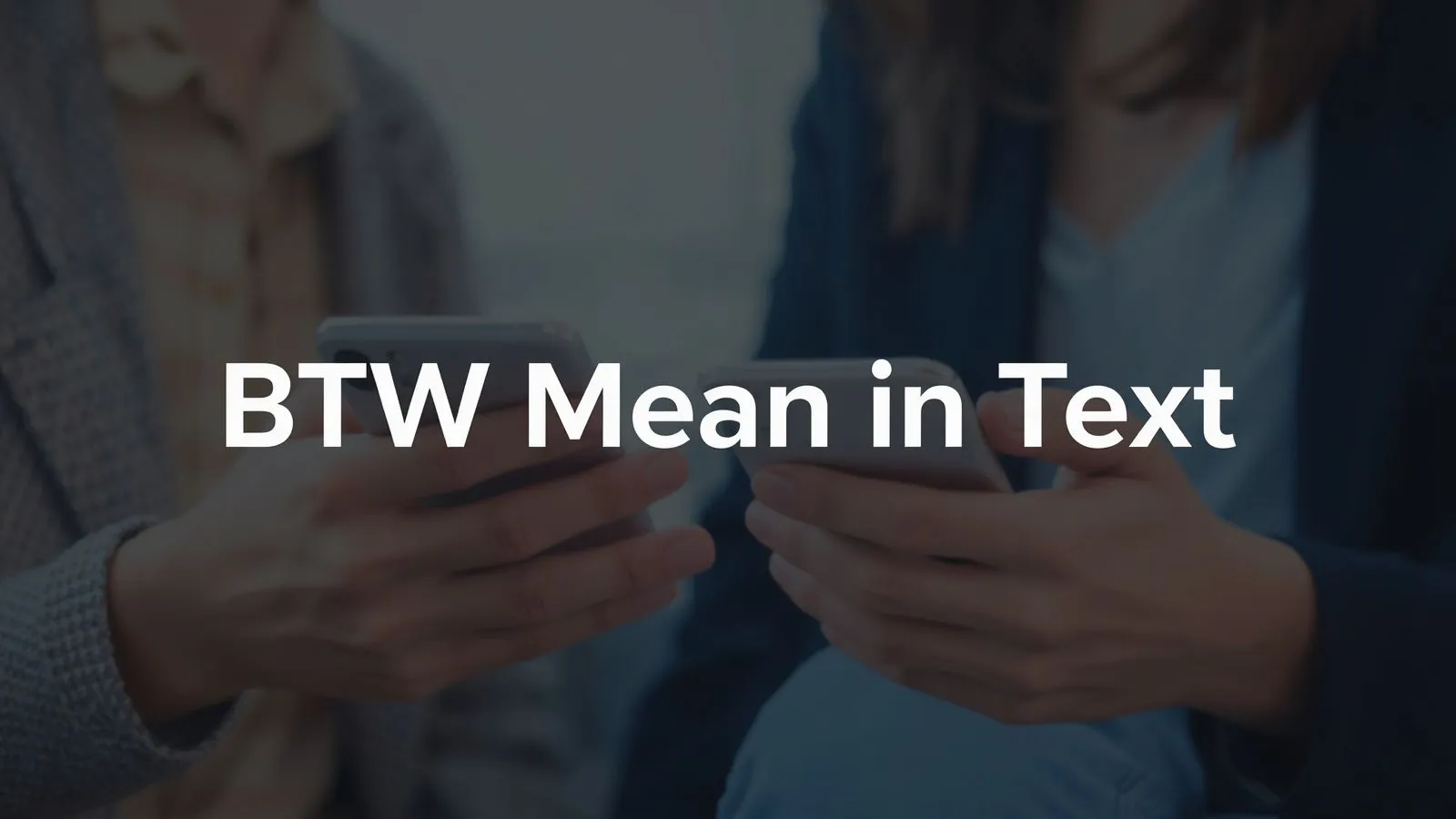
If you have received a message containing “BTW”, you may have wondered what those three letters mean. In texting and online communication, BTW means “by the way.”
It is one of the most common internet abbreviations and is used when someone wants to introduce an additional thought, change the subject slightly, add information, or mention something they almost forgot to say.
For example, someone might text, “BTW, are you coming tonight?” Here, BTW simply means “by the way.”
People often search for the meaning of BTW because abbreviations can sometimes be confusing, especially when they appear without context. The good news is that its everyday meaning is straightforward.
It is generally casual, friendly, and suitable for conversations with friends, family, classmates, and people on social platforms.
This guide explains how BTW is used across different platforms and contexts, how it differs from similar expressions, and how you can respond naturally when someone uses it.
Meaning & Definition
BTW stands for “by the way.” It is an informal abbreviation commonly used in text messages, online chats, comments, and social media conversations.
The phrase “by the way” is normally used to introduce information that is connected to the conversation but is not necessarily the main topic. Instead of typing the complete phrase, people often shorten it to BTW because it saves time and makes digital communication quicker.
Examples
- “BTW, I finished the assignment.”
- “BTW, what time are we meeting?”
- “I liked your new profile picture, BTW.”
- “BTW, did you call Sarah?”
- “The movie was great BTW.”
The abbreviation can appear at the beginning, middle, or end of a sentence. Its meaning remains essentially the same.
BTW can be used to add a reminder, ask a question, introduce a new topic, share an interesting detail, or make an additional comment. For example, “BTW, your package arrived” adds a piece of information to the conversation.
It is usually pronounced by saying the individual letters: “B-T-W.” However, in everyday conversation, people generally say “by the way” rather than pronouncing the abbreviation.
The expression is usually casual rather than formal. You might comfortably use BTW in a message to a friend, but writing “by the way” is generally more appropriate in a formal business email, academic assignment, or official document.
In short, when you see BTW in a text, the safest interpretation is “by the way.” The exact tone depends on the surrounding conversation, but the basic purpose is to introduce an additional thought or piece of information.
Background
The phrase “by the way” existed long before texting, smartphones, and social media. English speakers have traditionally used it as a conversational expression for introducing an extra point or moving briefly to another subject.
The abbreviation BTW became popular as digital communication developed. Early internet users, chat participants, and people communicating through text messages often shortened common phrases to make typing faster.
As mobile phones and instant messaging became widespread, abbreviations such as BTW became familiar to millions of users.
Unlike some newer slang expressions, BTW is not strongly tied to a particular generation or online community. Teenagers, adults, professionals, and casual internet users may all understand it.
Its popularity comes partly from its simplicity. The three letters communicate a phrase that would otherwise require several words. In a fast-moving conversation, this makes the abbreviation convenient.
For example:
“BTW, I saw your brother yesterday.”
is simply a shorter version of:
“By the way, I saw your brother yesterday.”
The abbreviation does not normally change the fundamental meaning of the sentence. Instead, it changes the style and speed of communication.
Over time, BTW became especially common on messaging platforms, discussion forums, social networks, and comment sections. It is now widely recognized as a standard piece of internet shorthand.
The expression also became useful because online conversations do not always follow a perfectly structured sequence.
Someone may suddenly remember something important and add it with “BTW.” A person might also use it to transition from one subject to another without making the change feel abrupt.
For instance:
“Are you free tomorrow? We could go for coffee. BTW, did you hear that Ali got a new job?”
The speaker has moved from plans for tomorrow to a separate piece of news. BTW makes that transition feel natural.
Therefore, the history of BTW is closely connected to the broader development of informal digital communication. It represents a simple idea: shorten familiar expressions so conversations can move faster.
Usage in Different Contexts: Chat, Social Media, and Professional Fields
BTW is most common in informal communication, but its acceptability depends heavily on the context.
In casual chat
Friends commonly use BTW when adding an extra question, reminder, or piece of information.
“BTW, bring your charger tomorrow.”
Here, the person is adding a reminder to the conversation.
On social media
BTW can appear in comments, captions, replies, and direct messages. Someone might write:
“BTW, your photos look amazing!”
The abbreviation keeps the message relaxed and conversational.
In online communities
Forums and discussion groups may also use BTW when someone wants to introduce a related point without starting a completely new discussion.
In professional communication
The situation is different in workplaces. Although many people understand BTW, it can sound overly casual in formal communication. In a professional email, it is usually better to write “by the way,” “additionally,” “also,” or another appropriate transition.
For example, instead of:
“BTW, the report is ready.”
a more professional version could be:
“By the way, the report is ready.”
Or, depending on the purpose:
“Also, the report is ready for review.”
The choice depends on the relationship between the people communicating and the formality of the setting.
In academic writing
BTW is generally inappropriate in formal essays, research papers, reports, and other academic writing. The complete phrase or a more precise transition should be used instead.
In customer service
Businesses may avoid BTW when communicating with customers because clear, professional language is usually preferred.
Overall, BTW is highly useful when the communication is informal. It should not automatically be considered incorrect; rather, it is a context-dependent abbreviation. Understanding your audience is the key to using it appropriately.
Meaning in Chat, WhatsApp, Instagram, and TikTok
On modern social platforms, BTW almost always means “by the way” when it appears in ordinary conversation.
WhatsApp users frequently use BTW when adding something to an ongoing conversation.
“BTW, what are you doing tonight?”
The person is asking a question that is somewhat separate from the previous topic.
Another example is:
“BTW, don’t forget about tomorrow’s class.”
Here, BTW introduces a reminder.
On Instagram, BTW may appear in direct messages, comments, or captions. Someone could comment:
“BTW, where did you buy that jacket?”
The person is adding a question while maintaining a casual tone.
TikTok
TikTok users may use BTW in comments or direct messages when adding a thought related to a video.
For example:
“BTW, this song is stuck in my head now 😂”
The abbreviation contributes to the informal, conversational style commonly found on the platform.
Group chats
BTW can be particularly useful in group chats because conversations often contain several subjects at once.
“BTW, who has the notes from today’s lecture?”
The abbreviation signals that the sender is introducing another point.
Tone and punctuation
BTW can be written as BTW, btw, or occasionally Btw. Capitalization generally does not change its meaning.
The tone can range from completely neutral to playful depending on the rest of the message.
For example:
“BTW, thanks for helping me yesterday.”
sounds appreciative.
“BTW 👀, I know what happened.”
could sound teasing or suggestive.
Therefore, the letters themselves do not determine the emotional meaning. The surrounding words, punctuation, emojis, and relationship between the people involved provide the context.
Meaning in Physics, Medical, and Aircraft Terminology
When people ask about BTW in specialized fields such as physics, medicine, or aviation, it is important not to assume that the texting abbreviation automatically applies.
In ordinary digital communication, BTW means “by the way.” However, technical fields frequently use abbreviations for specialized terms, and the same combination of letters can potentially have different meanings depending on the organization, textbook, document, or professional discipline.
Physics
There is no single universally applicable physics meaning of BTW that should replace the everyday texting interpretation in every situation. If BTW appears in a physics document, lecture note, diagram, or research paper, its meaning should be determined from the surrounding material or the document’s abbreviation list.
Medical terminology
Medical communication contains many abbreviations, but BTW should not automatically be interpreted as a standard medical term. In a medical record or clinical document, the exact source and context matter. Medical abbreviations can vary between institutions and specialties, so guessing can be unsafe.
Aircraft and aviation terminology
Aviation also relies heavily on standardized abbreviations and codes. If BTW appears in an aircraft-related manual, flight document, technical report, or operational communication, it may have a specialized meaning—or it may simply be an informal note saying “by the way.” The surrounding terminology should be checked before assigning a technical definition.
This distinction is important because the same three letters can have different meanings in different fields.
If you encounter BTW in a technical document, look for a glossary, abbreviation list, surrounding definitions, or the terminology used by the relevant organization. In casual texting, however, “by the way” is overwhelmingly the most natural interpretation.
Common Misconceptions
Several misunderstandings can arise when people encounter BTW for the first time.
Misconception 1: BTW is always slang
BTW is informal internet shorthand, but it is not necessarily “slang” in the same sense as highly localized or rapidly changing expressions. It is a widely recognized abbreviation for an established English phrase.
Misconception 2: BTW has a negative meaning
BTW does not inherently express anger, sarcasm, criticism, or disrespect. Its basic function is simply to introduce an additional thought.
For example:
“BTW, I really appreciate your help.”
is positive.
Misconception 3: BTW always means the speaker is changing the subject
Not necessarily. The additional information can be closely related to the existing conversation.
“I finished the project. BTW, I sent you the file.”
Both statements concern the same general subject.
Misconception 4: BTW is appropriate everywhere
It is widely understood, but that does not mean it belongs in every type of writing. Formal academic and professional documents generally benefit from complete words and more precise transitions.
Misconception 5: Capital letters change the meaning
“BTW,” “btw,” and “Btw” generally mean exactly the same thing.
Misconception 6: BTW has only one possible interpretation in every field
Context matters. In ordinary texting, “by the way” is the expected meaning. Technical environments can use abbreviations differently, so specialized documents should be interpreted using their own terminology.
The most important rule is simple: look at the surrounding message before interpreting an abbreviation.
Similar Terms & Alternatives
Several expressions can perform a similar conversational function to BTW.
“By the way”
This is the complete form of BTW. It is appropriate in both casual and many professional situations.
Example:
“By the way, your presentation was excellent.”
“Also”
“Also” can introduce another piece of information without necessarily implying a topic change.
Example:
“Also, remember to submit the form.”
“Speaking of…”
This expression is useful when the new topic is directly connected to something already being discussed.
Example:
“Speaking of movies, have you watched the new one?”
“Oh, and…”
This is very conversational and often used when someone remembers another point.
Example:
“Oh, and don’t forget your keys.”
“Incidentally”
“Incidentally” has a more formal or literary tone and can introduce additional information.
“On another note”
This phrase signals a more noticeable shift in topic.
Example:
“On another note, how is your new job going?”
“BTW” vs. “also”
Often BTW has a conversational “I just wanted to mention something else” feeling, while “also” can connect information more directly.
“BTW” vs. “FYI”
These are not identical. FYI means “for your information” and usually introduces information the recipient should know. BTW simply introduces an additional thought.
Understanding these differences helps you choose language that matches the situation and tone.
How to Respond to BTW
There is no special response required when someone uses BTW. You simply respond to the information or question that follows it.
For example:
Person A: “BTW, are you coming tomorrow?”
Person B: “Yes, I’ll be there around 6.”
If BTW introduces a reminder:
Person A: “BTW, don’t forget the meeting.”
Person B: “Thanks for reminding me!”
If it introduces a new topic:
Person A: “BTW, did you watch the match?”
Person B: “Not yet. Was it good?”
Sometimes the person may use BTW at the end of a message:
“Your idea was great, BTW.”
You can simply respond to the compliment:
“Thanks! I appreciate that.”
If you do not understand what the sender means, asking for clarification is perfectly reasonable:
“BTW, what do you mean?”
However, because BTW itself is so common, the part that needs clarification is usually the information following it rather than the abbreviation.
Your response should match the tone of the conversation. In a casual chat, you can use another informal expression such as “yeah,” “sure,” “oh, really?” or even BTW yourself. In professional communication, a more complete and direct response is usually preferable.
Differences From Similar Words
BTW is sometimes confused with other abbreviations, but each has a distinct function.
| Abbreviation | Meaning | Typical purpose |
| BTW | By the way | Adds another thought or topic |
| FYI | For your information | Provides information |
| TBH | To be honest | Introduces an honest opinion |
| IMO | In my opinion | Introduces a personal viewpoint |
| AFAIK | As far as I know | Indicates limited certainty |
| NGL | Not gonna lie | Introduces a candid statement |
| BRB | Be right back | Indicates temporary absence |
| IDK | I don’t know | Expresses uncertainty or lack of knowledge |
Consider the difference:
“BTW, the meeting starts at 5.”
The sender is adding information.
“FYI, the meeting starts at 5.”
The sender is emphasizing that the information should be known.
“TBH, I don’t like the new schedule.”
The sender is giving an honest opinion.
“IMO, the old schedule was better.”
The sender is identifying a personal opinion.
These abbreviations can appear together in the same conversation, but they perform different communicative jobs.
For example:
“BTW, FYI, the meeting was moved to Friday.”
Here, BTW introduces the extra point, while FYI emphasizes that the recipient should know the information.
The distinction becomes particularly useful when interpreting tone. BTW is generally neutral and conversational, whereas some abbreviations reveal the speaker’s attitude, certainty, or purpose more directly.
Relevance in Online Conversations & Dating Apps
BTW is common in online conversations because digital communication often develops through short, informal messages. People frequently remember additional information after sending a message, move between topics, or introduce a new question.
This is especially noticeable on dating apps, where conversations can move quickly from one subject to another.
For example:
“Your travel photos are amazing! BTW, what’s your favorite place you’ve visited?”
The BTW makes the transition into a new question feel casual.
Another example:
“I’m into hiking too. BTW, are you free this weekend?”
Here, the sender connects the new question to the existing conversation while keeping the tone relaxed.
BTW does not inherently indicate romantic interest. If someone uses it in a dating conversation, the meaning is still simply “by the way.” Any romantic or flirtatious meaning comes from the surrounding message, not from the abbreviation itself.
For example:
“BTW, you looked really good in that photo 😏”
may sound flirtatious because of the compliment and emoji, not because BTW has a hidden romantic definition.
Likewise:
“BTW, are you seeing anyone?”
could be a personal or potentially romantic question, but the abbreviation itself remains neutral.
The same principle applies to social media conversations. Context determines tone.
When interpreting messages online, it is better to consider the whole sentence, previous messages, punctuation, emojis, and relationship between the people rather than assigning a special meaning to BTW.
Conclusion
BTW means “by the way” in text and online communication. It is a common abbreviation used to introduce an additional thought, reminder, question, detail, or slight change of subject.
You may encounter it in WhatsApp messages, Instagram DMs, TikTok comments, group chats, and other informal digital conversations.
Its meaning is generally straightforward, although technical contexts such as medicine, physics, or aviation may use abbreviations differently.
In those settings, the surrounding document or field-specific terminology should be checked rather than assuming the texting definition.
BTW is friendly and casual, making it suitable for everyday conversations but less appropriate for formal academic or professional writing. It also does not automatically indicate sarcasm, romance, annoyance, or any other hidden emotion.
When someone sends you a message containing BTW, simply focus on the information that follows it. Once you recognize that BTW means “by the way,” most messages containing the abbreviation become easy to understand.

Alex Morgan is a professional writer at Guestreachs.com, who specializes in explaining modern slang, texting abbreviations, and everyday expressions. He creates simple, reader-friendly content designed to make unfamiliar meanings easy to understand.