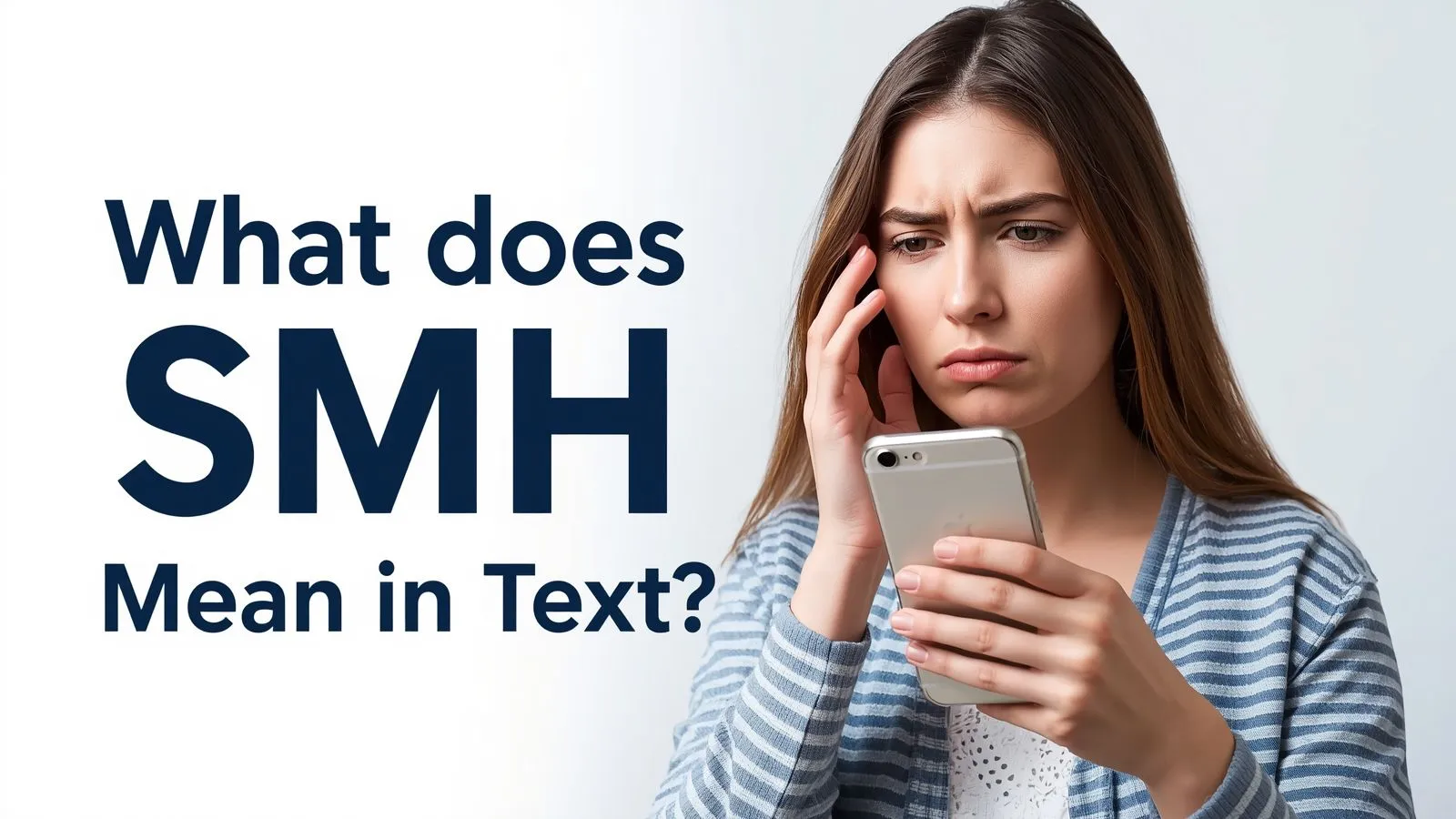
If you have ever received a text such as “SMH, I can’t believe you did that,” you may have wondered what SMH means in text. SMH is a popular internet abbreviation that people use in everyday digital conversations, especially when texting, commenting, or posting on social media.
In most casual conversations, SMH means “shaking my head.” It expresses disappointment, disbelief, annoyance, embarrassment, or mild frustration about something someone has said or done. Depending on the situation, it can be playful rather than genuinely angry.
People commonly search for this abbreviation because its meaning can change slightly according to context and tone. Understanding it can make conversations on WhatsApp, Instagram, TikTok, Snapchat, dating apps, and other platforms much easier to follow.
This guide explains the meaning of SMH, its background, common uses, examples, related expressions, possible meanings in specialized fields, and appropriate ways to respond.
Meaning & Definition
SMH primarily stands for “shaking my head.” It is a shortened expression used in digital communication to show a reaction to something considered disappointing, foolish, surprising, frustrating, or unbelievable.
The phrase comes from the physical gesture of shaking your head from side to side. People often shake their heads when they disagree with something, cannot believe what happened, or feel disappointed by someone’s actions. SMH transfers that reaction into written communication.
For example:
- “You forgot your keys again, SMH.”
- “SMH, I told you to check the address.”
- “He really posted that? SMH.”
- “SMH, we missed the bus by one minute.”
The abbreviation does not always communicate serious anger. Its emotional strength depends on the conversation. A friend might write “SMH 😂” after another friend makes an obviously silly mistake. In that case, it can be humorous and affectionate.
It can also express disbelief:
“You watched the entire movie and still don’t know who the villain was? SMH.”
Here, the speaker is not necessarily angry. They are simply reacting to something they find difficult to believe.
SMH can appear at the beginning, middle, or end of a message. For example, “SMH, that was a terrible decision” places emphasis on the reaction, while “That was a terrible decision, SMH” makes it sound more like an afterthought.
Although “shaking my head” is the standard meaning, readers should always consider the surrounding message. Abbreviations can sometimes have specialized meanings in professional or technical environments.
Background
SMH developed as part of the broader growth of internet shorthand and text messaging. As online communication became faster and more informal, users began shortening common phrases into a few letters.
Expressions such as LOL, OMG, BTW, IDK, and SMH became convenient ways to communicate emotions without writing a complete sentence.
The basic idea behind SMH is older than texting itself. People have long used head-shaking as a nonverbal reaction to disappointment, disbelief, disagreement, or frustration. Digital communication simply gave people a quick written way to represent that reaction.
SMH became particularly recognizable through online forums, instant messaging, social networks, and mobile texting. As social media became a major part of everyday communication, the abbreviation spread across different communities and age groups.
Its popularity also comes from its flexibility. A person can use SMH seriously, sarcastically, humorously, or casually. The surrounding words, punctuation, capitalization, and emojis can help determine the intended tone.
Compare these examples:
- “SMH. That was incredibly rude.”
- “smh 😂 you actually believed him?”
- “You bought another phone? SMH.”
The first sounds more critical, the second is playful, and the third could be teasing.
Today, SMH is widely understood in informal online communication. However, it is still generally considered casual language. It may be perfectly natural in a text message or social-media comment but inappropriate in a formal business report, academic paper, or official document.
Usage in Different Contexts
The meaning and tone of SMH can vary depending on where it appears. In chat, it is usually a quick emotional reaction. Someone may type “SMH” after hearing about a mistake, strange decision, or unexpected event.
In social media, SMH frequently appears in captions, comments, replies, and posts. People may use it to react to news, trends, arguments, celebrity behavior, funny situations, or posts they find ridiculous.
For example:
“He said pineapple doesn’t belong on pizza. SMH.”
Here, the writer is expressing playful disagreement rather than serious disappointment.
In a professional field, SMH should be interpreted carefully. Informal workplace messaging between colleagues may occasionally contain internet abbreviations, but formal communication usually avoids them.
If someone sends “SMH” in a workplace chat, the intended meaning may still be “shaking my head,” but the tone could be interpreted as criticism.
In academic or technical contexts, an abbreviation should not automatically be interpreted as internet slang. Specialized industries frequently use the same combinations of letters for completely different terms.
This is why context matters. A message such as “SMH, I cannot believe this happened” strongly indicates the slang meaning. A technical document containing “SMH” alongside industry-specific terminology may require a different interpretation.
When communicating professionally, spelling out the intended meaning or using clearer language can prevent misunderstandings. For example, instead of writing “SMH,” someone might say, “I’m disappointed that this happened.”
Meaning in Chat, WhatsApp, Instagram, and TikTok
On messaging and social-media platforms, SMH usually means “shaking my head.” Its meaning remains essentially the same across WhatsApp, Instagram, TikTok, Snapchat, Facebook, and similar platforms.
SMH in Chat
In a private conversation, SMH is often used as a short reaction.
Example:
Friend: “I left my wallet at home again.”
You: “SMH 😂”
The response means something like, “I’m shaking my head at you,” but it may be intended jokingly.
SMH on WhatsApp
WhatsApp users may use SMH in individual messages, group chats, or status replies.
Example:
“SMH, why did nobody tell me the meeting was moved?”
It communicates frustration or disbelief.
SMH on Instagram
On Instagram, SMH can appear in comments or direct messages.
“SMH, people really believe this?”
Here it shows disbelief or disagreement with a post.
SMH on TikTok
TikTok users may use SMH when reacting to a video, story, opinion, or humorous situation.
“SMH, he really thought that would work 😂.”
The expression can be sarcastic, amused, or critical depending on the video and surrounding context.
Tone Matters
Emojis can significantly change the tone. “SMH 😭” may indicate humorous disbelief, while “SMH.” may sound more serious or annoyed.
Therefore, when interpreting SMH, consider the complete message rather than treating the abbreviation as a fixed emotional response.
Meaning in Physics, Medical, and Aircraft Terminology
The slang meaning of SMH is by far the most relevant interpretation when the abbreviation appears in ordinary texting. However, SMH can have other meanings in specialized environments. There is no single universal technical definition for the letters SMH across physics, medicine, and aviation.
SMH in Physics
In physics or scientific writing, an abbreviation such as SMH may be defined by a particular textbook, research paper, institution, or technical system. It should not automatically be interpreted as “shaking my head” simply because the same letters are familiar from social media.
The surrounding terminology and the document’s abbreviation list are the best clues.
SMH in Medical Contexts
Medicine uses thousands of abbreviations, and the same abbreviation can have different meanings between specialties or organizations. SMH may therefore appear as an abbreviation for an institution, clinical term, or other medical reference depending on the source.
Medical abbreviations should always be interpreted from the specific clinical context rather than guessed from internet slang.
SMH in Aircraft or Aviation Terminology
Aviation also uses standardized abbreviations, airport identifiers, aircraft-related codes, and operational terminology. If SMH appears in an aviation document, flight-related system, or airport reference, its meaning may be unrelated to “shaking my head.”
For this reason, context is essential. In a text message, “SMH” almost certainly refers to the slang expression. In a technical document, check the relevant glossary, manual, database, or coding system before assigning a meaning.
Common Misconceptions
One common misconception is that SMH always means the person is angry. That is not necessarily true. Although it can express frustration or disappointment, it is also frequently used jokingly.
For example:
“You forgot your own birthday? SMH 😂”
This is more likely playful teasing than genuine anger.
Another misconception is that SMH has only one possible interpretation in every environment. In casual texting, “shaking my head” is the standard meaning. However, specialized organizations can use the same letters as an abbreviation for unrelated terms.
Some people also assume that SMH is rude. Its tone depends heavily on the relationship between the speakers and the surrounding conversation. Between close friends, it can be harmless humor. Between strangers or colleagues, it may sound dismissive or judgmental.
Another misunderstanding concerns capitalization. SMH, smh, and sometimes Smh generally refer to the same slang expression. Capitalization usually does not change its meaning.
Finally, SMH does not always mean literal head-shaking. Most users are not physically shaking their heads while typing it. It is simply a written representation of a familiar reaction.
Similar Terms & Alternatives
Several internet expressions can communicate emotions similar to SMH, although they are not exact replacements.
Facepalm
“Facepalm” describes putting a hand over your face because something is embarrassing, foolish, or frustrating.
Example:
“Facepalm. I sent the email to the wrong person.”
Seriously?
“Seriously?” expresses disbelief or annoyance.
Example:
“You forgot the tickets? Seriously?”
OMG
“OMG,” meaning “oh my God” or “oh my gosh,” is usually broader. It can express surprise, excitement, shock, or disbelief.
WTF
“WTF” is a much stronger and often more vulgar expression of confusion, shock, or frustration. It should not automatically be substituted for SMH.
LOL
“LOL,” meaning “laughing out loud,” usually indicates amusement. It may occasionally accompany SMH when something is both frustrating and funny.
IDK
“IDK” means “I don’t know.” It expresses uncertainty rather than the disappointment or disbelief normally conveyed by SMH.
Choosing the right abbreviation depends on the emotion you want to communicate. SMH is particularly useful when your reaction is essentially, “I cannot believe this.”
How to Respond to SMH
The best response depends on why the other person used SMH. If they are joking, you can respond playfully. If they sound disappointed, acknowledging the situation may be better.
If They Are Teasing
You could say:
- “😂 What did I do now?”
- “I know, I know!”
- “Don’t judge me 😂”
- “It seemed like a good idea at the time.”
If They Are Disappointed
A more serious response may work better:
- “Yeah, I understand.”
- “You’re right. I should have handled it differently.”
- “Sorry about that.”
- “I’ll make sure it doesn’t happen again.”
If You Don’t Understand the Context
Simply ask:
“What do you mean?”
There is no need to assume that SMH is negative. Look at the conversation before deciding how the sender intended it.
If someone sends “SMH 😂,” the laughing emoji is a useful clue that the message may be playful. If they send “SMH. I expected better,” the tone is considerably more serious.
Differences From Similar Words
Although several slang expressions can communicate frustration or disbelief, their emotional meanings differ.
SMH focuses on disappointment, disbelief, or a reaction to someone’s behavior.
Facepalm emphasizes embarrassment or frustration caused by something foolish.
OMG mainly expresses surprise or shock and can be either positive or negative.
WTF usually expresses stronger shock, confusion, or anger and contains profanity in its expanded form.
Seriously? directly questions whether something is actually happening or whether someone is being genuine.
LOL indicates amusement rather than disappointment, although it can sometimes be used sarcastically.
For example, imagine a friend says:
“I studied for five hours and forgot to take the exam.”
Possible reactions include:
- “SMH 😂” — playful disappointment or disbelief.
- “Facepalm.” — the situation is painfully foolish.
- “OMG!” — shock or surprise.
- “Seriously?” — disbelief.
- “WTF?” — strong shock or frustration.
- “LOL” — amusement at the situation.
These expressions can overlap, but they communicate different emotional shades.
Relevance in Online Conversations & Dating Apps
SMH is also common in online dating conversations because dating apps rely heavily on short, informal messages. Someone might use it when a match makes an unexpected comment, forgets something they previously discussed, or tells a funny story.
For example:
“You said you don’t like coffee but your profile has five coffee pictures. SMH 😂”
This would probably be playful.
However, tone can be difficult to read online. Without facial expressions or voice, an abbreviation such as SMH may appear more critical than intended. This is especially important when communicating with someone you have only recently met.
If a dating-app match writes “SMH,” consider the surrounding message before responding defensively. They may be joking, flirting, teasing, or genuinely expressing annoyance.
SMH can also contribute to playful banter:
Person A: “I can’t believe you picked that restaurant.”
Person B: “SMH, you literally recommended it yesterday 😂.”
In this situation, the abbreviation helps make the conversation feel casual and humorous.
Nevertheless, if a conversation is becoming serious, relying too heavily on abbreviations can create confusion. Clear language is usually better when discussing feelings, boundaries, or disagreements.
Conclusion
So, what does SMH mean in text? In ordinary online communication, SMH means “shaking my head.” People use it to express disbelief, disappointment, frustration, disagreement, embarrassment, or playful teasing.
You can find it in text messages, WhatsApp chats, Instagram comments, TikTok conversations, dating apps, and other informal digital spaces. Its exact tone depends on the situation, the relationship between the speakers, and accompanying words or emojis.
Although “shaking my head” is the standard slang interpretation, SMH can have different meanings in specialized technical environments. When it appears in medical, scientific, aviation, or other professional material, context should always be checked before interpreting it.
The easiest way to understand SMH is to think of it as a written version of the reaction, “I can’t believe this.” Once you recognize the context, the abbreviation is usually straightforward to understand.

Ethan Parker is a professional content writer and researcher at Guestreachs.com, specializing in word, phrase, and slang meanings. His goal is to provide accurate, straightforward explanations that help readers understand unfamiliar terms with ease.